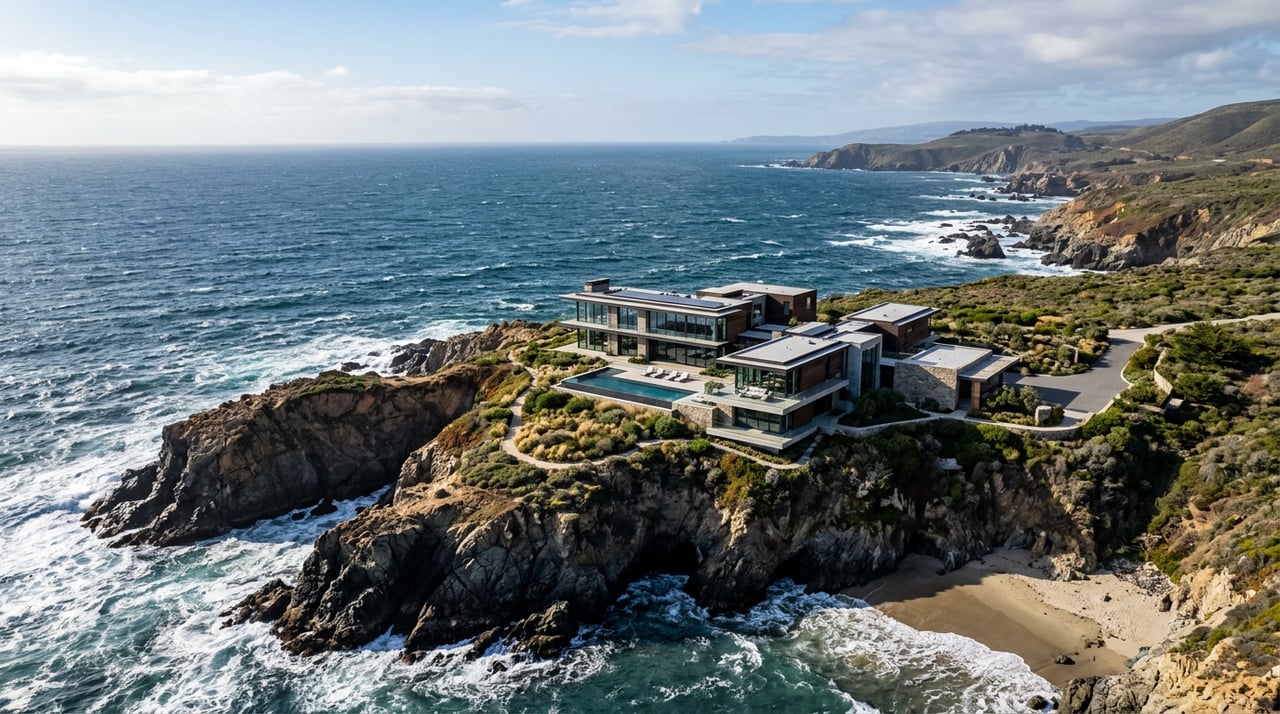
A three-acre sea-to-sea parcel on Stocking Island, beach on the harbor side and beach on the Atlantic side, is currently marketed as a blank canvas for a private estate. Elsewhere on the same island, a separate raw building lot is listed near $750,000. Neither listing mentions that the buyer will also need a generator, a solar array, and a working relationship with a boat captain, because the island itself has no bridge, no public road, and no shared power grid at all.
That gap between what the price tag covers and what ownership actually requires is the thing worth understanding before anyone from Nassau, Miami, or Toronto wires a deposit on a Stocking Island lot. The beach is real. The scarcity is real. But the number on the listing is pricing the view, not the cost of living there.
The only road to the property is water
Stocking Island sits directly across Elizabeth Harbour from George Town, close enough to see the town's rooftops but reachable only by boat. There is no causeway, no car ferry, nothing that resembles a driveway. Chat 'N' Chill, the beach bar that anchors the island's social life, puts it plainly on its own site: no roads, no bridges, you take a boat or a seaplane, or you swim if you're brave.
In practice, getting to and from the island runs through a small number of independent operators. Elvis Water Taxi, started in 2006 by Captain Elvis Ferguson, who has served as Elizabeth Harbour's Harbour Master since 1999, is one of the names visitors and residents mention most. A1 Water Taxi and Martin's Ferry Service round out the regular options, all running out of the government dock in George Town on schedules that lean informal. Round trips have run anywhere from $12 to $25 a person depending on the operator and the year, with boats typically going on the hour but not always exactly on the hour.
For a vacationer, that unpredictability is charming. For a property owner, it's a supply chain. Every contractor, every appliance delivery, every bag of concrete, and every grocery run has to clear that same water gap. One review of a marina stay on the island noted the property's own water taxi was, in the guest's words, "very useful in getting over to Georgetown for groceries, ice, etc." That's not a lifestyle detail. That's logistics a full-time or seasonal owner needs to plan around every week.
This is also where resale value quietly divides the market. Local commentary on the Exuma market has pointed out that boating access functions as a fundamental part of how people actually use their property here, not just a nice-to-have, and that homes without dock access trade at a real discount to those with it. If you're comparing two Stocking Island parcels at similar price points, the one with a private dock or deep-water frontage is doing something the other one isn't, and buyers who skip that comparison find out at resale.
The power grid that isn't there
Here's the detail that surprises people who've only shopped mainland Bahamian real estate: Stocking Island has no shared electrical grid. Not a weak one, not an unreliable one. None.
The clearest confirmation of this comes from the island's own commercial infrastructure. A guest review of St. Francis Resort & Marina, a working 22-slip marina on the island, described it directly: no common power, everyone is on their own, and the marina itself runs off its own solar and generator setup, with dockside power going up and down a couple of times a day as a normal condition, not a malfunction. If a functioning marina with paying guests and a restaurant can't count on constant power, a raw land buyer certainly can't assume it either.
What that means in dollars is straightforward even without a specific quote in hand: anyone building on Stocking Island is budgeting for a private generation and storage system, whether that's a diesel generator, a solar and battery array, or both, plus a private cistern or desalination setup for water, on top of the land and the build itself. None of that shows up in the acreage price. It shows up in the second phase of the project, after closing, when the actual cost of occupying the lot starts to take shape.
What the price buys, and what it doesn't
| Stocking Island lot | Mainland George Town lot | |
|---|---|---|
| Access | Boat or water taxi only, no roads or bridges | Road access, car and truck delivery |
| Power | No shared grid, private solar or generator required | Connected to the island's electrical grid |
| Water and services | Private cistern or desalination typical | Municipal-style service through George Town |
| Daily logistics | Contractors, deliveries, groceries all cross by water | Direct vehicle access to hospital, schools, supermarkets |
| Draw | Beachfront scarcity, harbor and Atlantic frontage, proximity to Chat 'N' Chill and the marina community | Practical base for full-time living, closest to George Town's hospital, schools, supermarkets, marina, and airport |
George Town remains the commercial and residential center of Great Exuma, with the hospital, schools, supermarkets, a marina, and the airport all in reach by car. That's the practical trade-off buyers are weighing whether they realize it or not: Stocking Island sells scarcity and setting, George Town sells convenience and infrastructure that's already built and already someone else's problem to maintain.
Why buyers pay the premium anyway
None of this makes Stocking Island a hard sell. It makes it a specific one.
Chat 'N' Chill traces back to 1998, when it started as a day camp for people living aboard their boats in Elizabeth Harbour, a place to get a meal, play volleyball, and even attend Sunday services without needing a car, because there wasn't one to need. That history is baked into what the island is now: a barrier island with beaches on both the calm harbor side and the open Atlantic side, hiking trails, blue holes, and a marina community anchored around two protected coves known locally as hurricane hole one and hurricane hole two. Properties with Stocking Island frontage or harbor views are consistently described as among the most sought-after in the Exuma market, and that demand is exactly why undeveloped sea-to-sea parcels are still moving at prices in the mid six figures and up despite the infrastructure gap.
There's a transaction detail worth flagging here too. Bahamas real estate purchases above $1,000,000 qualify a buyer for Bahamas Economic Permanent Residency. Raw land on Stocking Island can currently be found under that number, but once a buyer adds a build, a private power system, and water infrastructure on top of the lot price, the total project cost can cross the threshold even when the land alone didn't. That's a detail worth raising with legal counsel early, before assuming the residency question is settled by the listing price alone.
What this means if you're comparing neighborhoods
If you're cross-shopping Stocking Island against a mainland Great Exuma lot, the honest comparison isn't beachfront versus no beachfront. It's total cost of occupancy versus acquisition price. A Stocking Island parcel can look like better value per square foot than a comparable George Town lot until you price in a private power system, a water system, and a standing arrangement with a water taxi operator for the life of your ownership. None of that is a reason to avoid the island. It's a reason to ask the right questions before you're under contract, and to budget the build differently than you would on a road-connected lot fifteen minutes away by car.
Development land in Exuma more broadly still trades below what comparable coastal acreage commands in more established Bahamian markets, which is part of why buyers with a longer horizon keep looking here. Stocking Island is simply the sharpest version of that trade: the discount on the land is real, and so is the bill you don't see until after closing.
If you're weighing a Stocking Island parcel against options on the Great Exuma mainland or elsewhere in the out islands, My Bahamas Realtor Properties can walk through what a specific lot actually requires to build on, not just what it costs to buy. Schedule a private consultation and we'll go through the numbers together before you make an offer.